


In my years of working with HR teams across Ghana, I have noticed something interesting. The best HR professionals are not the ones who never make mistakes.
The best HR professionals are the ones who know what to do when they do.
Let me be honest with you. HR staff make mistakes. Payroll errors happen. Policies are misapplied. Deadlines are missed. Documents get lost. Sometimes, a termination is handled poorly. Sometimes, advice given in good faith turns out to be wrong.
It happens. You are human.
When HR makes a mistake, it can significantly impact employee morale, legal compliance, and company reputation. The question is not whether you will make mistakes. The question is what you do when you do.
A sincere apology and rapid correction can save a career. Denial and defensiveness will destroy it.
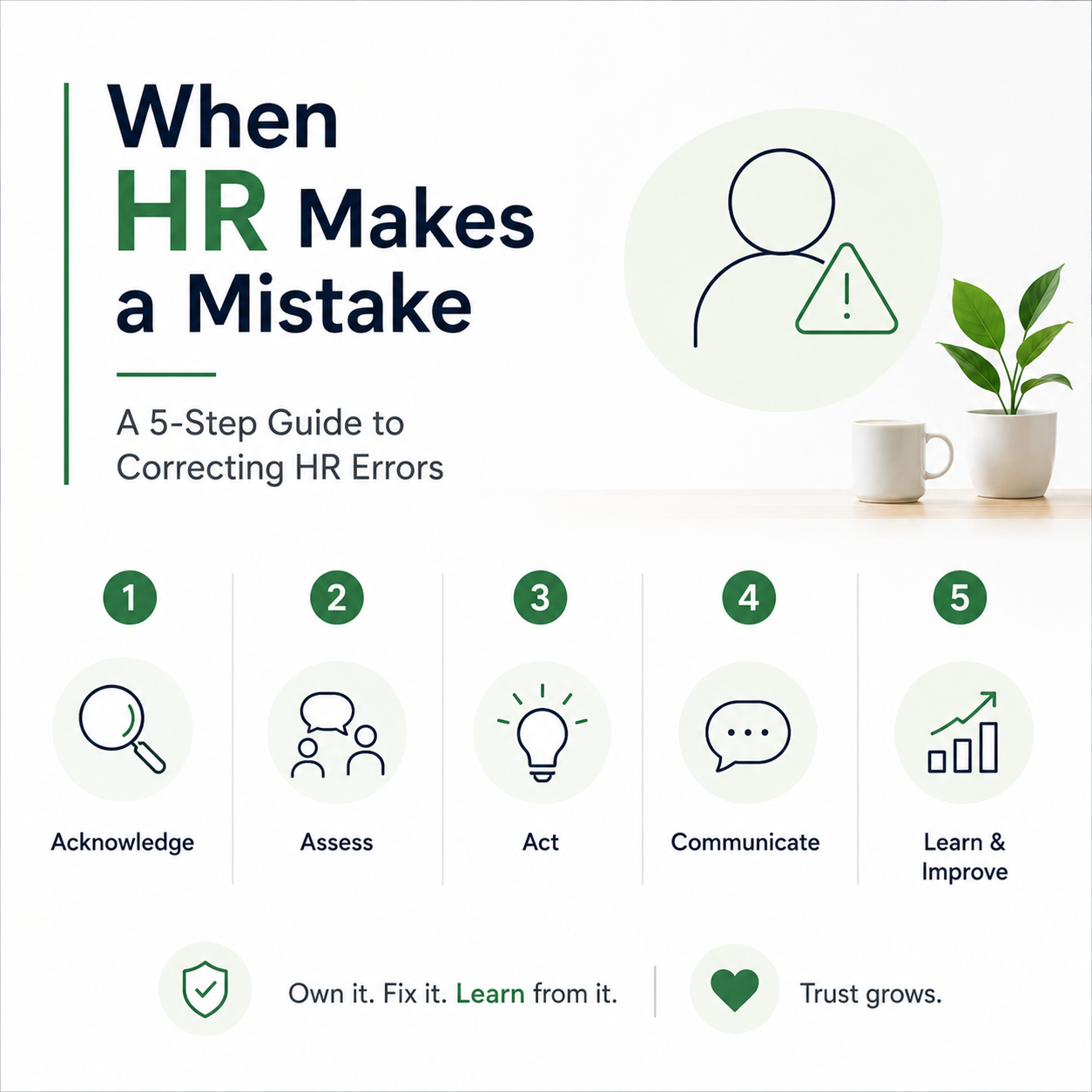
The 5 Steps to Correcting HR Errors
When you discover an HR error – or when an employee brings one to your attention – follow these five steps without hesitation.
Step One: Acknowledge the error without defensiveness.
Do not deflect. Do not justify. Do not explain away. When you defend a mistake, you are telling the employee that your ego matters more than their trust. Say this: “You are right. We made an error on your payslip. Thank you for bringing it to my attention.”
Step Two: Apologize sincerely.
A real apology has no “ifs” or “buts.” Do not say, “I am sorry if you were offended.” That is not an apology; that is blame-shifting.
Say this: “I am truly sorry this happened. I take full responsibility.”
Step Three: Correct the error as quickly as possible.
Speed communicates sincerity. If it is a payroll error, process the correction immediately. Do not wait for the next payroll cycle. If it is a misapplied policy, reverse the decision and reapply correctly.
A slow correction suggests a shallow apology.
If the mistake involves labor laws or compliance, involve legal counsel immediately to mitigate risks.
Step Four: Document what happened, how it was corrected, and when.
Write down the error. Write down how it happened. Write down what you did to fix it. Write down when you fixed it. Keep this record.
Why? Because if this issue ever comes up again – in a grievance, in an audit, or at the Labour Commission – you will need evidence of how you handled it. Good documentation protects both the employee and the organization.
Step Five: Learn and update procedures to prevent recurrence.
Ask yourself: “How can I ensure this never happens again?” Then make the change. Share the lesson with your team (without naming names). A culture that learns from mistakes is a culture that grows stronger.
What To Avoid
Do not hide the mistake. It will eventually surface. And when it does, the cover-up will be worse than the error itself.
Do not blame someone else. It destroys team trust and makes you look untrustworthy.
Do not pretend it did not happen. The employee knows it happened. Gaslighting only deepens the wound.
Do not minimize the employee’s experience. Do not say, “It was just a small error.” To the employee, it was not small. Respect their experience.
I once worked with an HR team in Accra where a payroll error underpaid a senior staff member for three months. The employee was furious – rightfully so.
The HR manager had a choice. He could defend the error. He could blame the finance department. He could wait for the next payroll cycle.
Instead, he called the employee into his office. He showed him the error log. He admitted the mistake. He apologized sincerely.
Then he personally processed a manual payment within 24 hours. He documented everything. And he implemented a new verification step in the payroll process.
The employee was still frustrated. But he said: “I appreciate that you owned up to it and fixed it. That is all I wanted.”
The relationship was saved. Trust was rebuilt.
Key Points for HR Practitioners
If you manage an HR team, create a culture where your people feel safe admitting mistakes. If they fear punishment for every error, they will hide their mistakes. And hidden mistakes grow into catastrophes.
Instead, say to your team: “When you make a mistake, come to me immediately. We will fix it together. We will learn from it. I will not punish honesty.”
That is how you build a resilient, trustworthy HR function.
Mistakes will happen. You will miscommunicate a policy. You will miscalculate a benefit. You will lose a document. You will advise a manager incorrectly.
The question is not whether you will make mistakes.
The question is what you do when you do.
A sincere apology and rapid correction can save a relationship. Denial and defensiveness will destroy it.
Choose wisely. I am an HR consultant and trainer based in Accra. Tel: 027-984-2335 | yvonne.wiredu-akpabli@h4factor.com
Post a comment
Related Posts

July 24, 2026
Contentment at Work: A Career Advantage, Not a Sign of Complacency
Why cultivating the right attitude at work could be the key to long-term career success…

May 14, 2026
Starting 2026 Strong: How to Plan, Reposition, and Win in the New Year
Every new year arrives with hope—but success belongs to those who prepare intentionally. For most…

May 13, 2026
Winning the Talent Game: Modern Recruitment & Selection Strategies for Ghanaian Companies
In today’s fast-paced VUCA business world, the ability to attract, select, and retain exceptional talent…
May 13, 2026
When HR Makes a Mistake: A 5-Step Guide to Correcting HR Errors
In my years of working with HR teams across Ghana, I have noticed something interesting.…